Are your air conditioners any good?
WE NEEDED A CLIENT. That's the truth of it.
An insurgent came to us, ready to run an account, ready to prove what this agency could be. We stopped her and said: that's great. But first, we need someone to test this on.
She came back a week later with Midea.
Midea is the third-largest small appliance maker in the world. Samsung's one, LG's two. Midea is third. Out of China. In Canada, nobody knew they existed.
This was 2021. Canada and China were going at it again politically. A lot of agencies were steering clear of Chinese-owned brands. That didn't bother us.
Their website was a platform built in China and shipped to every market with the same instructions: use this. The template was built for markets where people buy through Alibaba-style marketplaces — think category-less, no filters, everything commingled. In Canada, shoppers expect brand, then category, then subcategory, then product. The mismatch was stark. And from what we could tell, nobody in the Canadian office had the mandate or the leverage to fix it.
That's when the phone rang.
June 2021. COVID's shutting stores down across the country. A heat wave is hitting hard. The client calls and says: our air conditioners aren't selling. We want to run digital ads.
We could run ads. That's what agencies do when a client asks for ads. But we had a question first.
Are your air conditioners any good?
The client looked at us like we'd asked something strange. What do you mean? We mean exactly that. Is it the product? Is it awareness? Are they just not what people want right now?
She didn't know. They just weren't selling.
Every photo, same empty shelf
We did something we'd never tried before. We reached out to friends and family coast to coast. Vancouver, Regina, Halifax, and every city in between. Midea's products were at Home Depot, Rona, Lowe's, Canadian Tire. We asked people — if they were comfortable, COVID being what it was, to walk into those stores and see if they could find the product on the shelf.
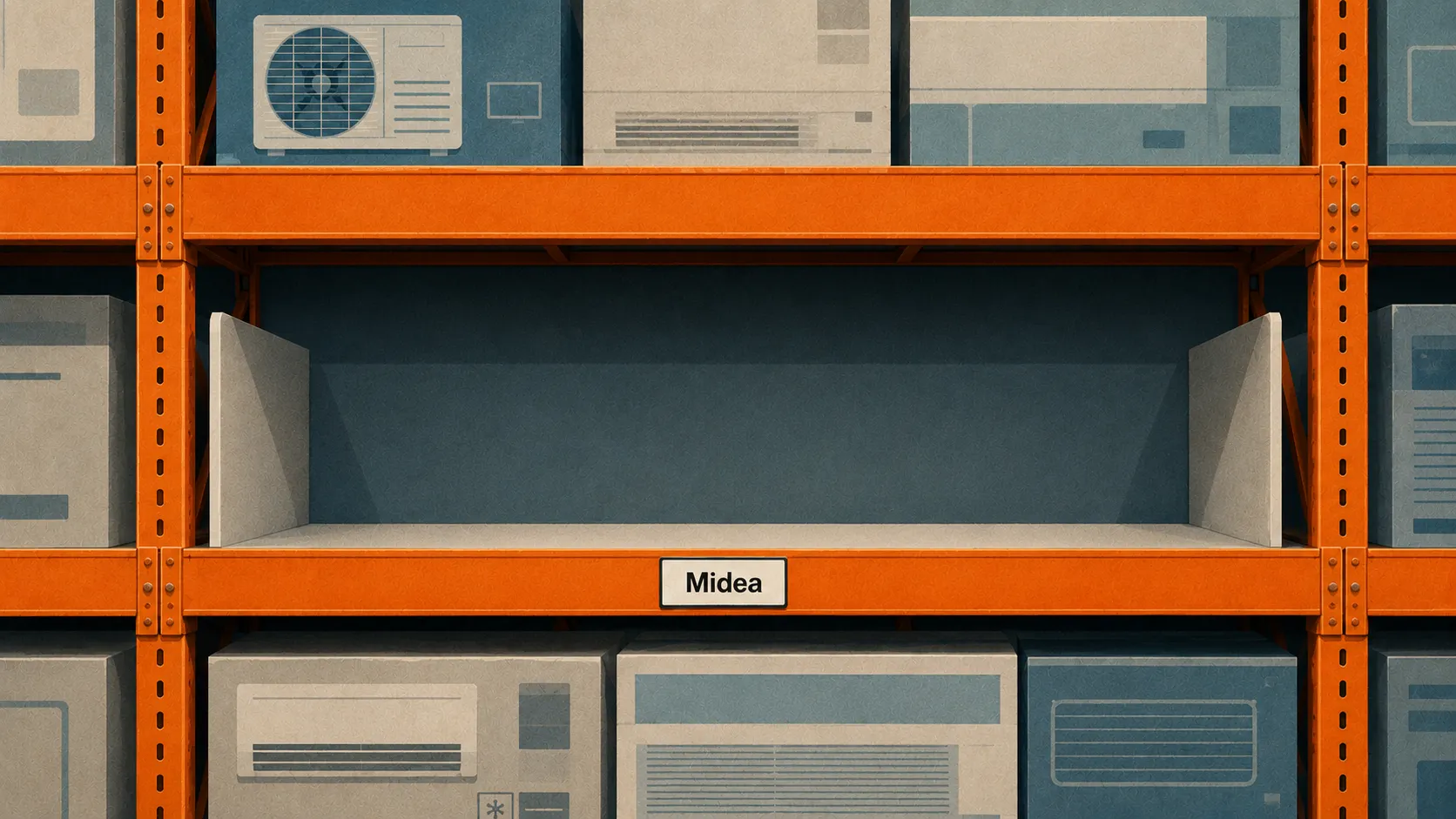
The photos came back from every province. Empty shelves, every time. The little plastic hang tag with Midea's name was there, marking the spot. The product wasn't. British Columbia, Ontario, Nova Scotia: the same photo, different fluorescent lighting. We had a data set now, and it all said the same thing.
We wondered if maybe it was an online-only problem. So, we recorded ourselves buying from three major retailers. Every single site, somewhere between "add to cart" and "checkout," threw a 404 error. The transaction couldn't complete.
The client came back with an approved ad budget. We didn't take it.
Instead, we showed her the evidence: the shelf photos from every province, laid out in a grid, the screen recording of the failed checkout, the pattern that was too consistent to be a coincidence.
"We don't think you have an advertising issue, we think you have a reporting issue. We think you're sold out at retail and nobody's told you."
She looked at the shelf photos. She watched the checkout video. She called her team. The next day, she called back.
"We're sold out. We actually are."
What we built instead of the ads
Now she had a new problem. The budget was approved. She didn't know what to do with it.
We told her: don't worry. We'll put it toward SEO. Toward accessibility. The site wasn't compliant anyway. We built something that worked instead. Let us figure out what's actually broken, fix that, and go from there.
That conversation eventually became a relationship spanning two brands, two websites, and new category launches for dishwashers and laundry. We became their media and digital agency of record without ever asking for the title. One day we looked up and realized we were running the digital strategy for a global top-three manufacturer. Not because we pitched a grand vision. Because we asked the obvious question, did the research, and told the truth instead of taking the money for ads that would've sent people to empty shelves.
That trust, earned through a few friends with camera phones and a hunch about a heat wave, opened the door to a harder question. The second piece in this series gets into what happened when we looked closer: re-engineering a global marketplace template into something that actually made sense for Canada.
We're looking for the next client who's ready to ask the obvious question before spending on the obvious answer. If that sounds like you, let's talk.

Contact us
Feel free to drop us a message or if you prefer to kick it old school give us a call at 416-602-2095.